
Polyfluoroalkyl substances (PFAS) have earned the nickname “forever chemicals” because they do not break down naturally in the environment or the human body. These synthetic compounds are found in nonstick cookware, waterproof clothing, food packaging, and firefighting foam. Public health officials have long warned about their potential health effects, including links to cancer and immune system disruption. Now, a new study has uncovered another alarming connection between PFAS aging and biological aging: specific PFAS compounds appear to speed up biological aging in men, particularly those in their fifties and early sixties.
The research, published in Frontiers in Aging in February 2026, was led by Dr. Xiangwei Li at Shanghai Jiao Tong University School of Medicine. Using data from the National Health and Nutrition Examination Survey, the team analyzed blood samples from 326 older adults in the United States and found that two per- and polyfluoroalkyl substances (PFASs) were strongly associated with accelerated epigenetic aging in middle-aged men. The findings suggest that not all PFAS carry the same risks and that some compounds deserve far more regulatory attention than they currently receive.
What Are Epigenetic Clocks and Why Do They Matter?
Every person has a chronological age, which is simply the number of years they have been alive. But biological age, which reflects the amount of wear and tear the body has accumulated, can be quite different. Two people who are both 55 on paper may have very different biological ages depending on their genetics, environment, and lifestyle factors.
Scientists measure biological age using tools called epigenetic clocks. These algorithms analyze chemical modifications to DNA known as methylation patterns. By examining the DNA methylome in blood cells, researchers can estimate how quickly a person’s body is aging at the molecular level. The research team applied 12 established epigenetic clocks, including GrimAge, which is specifically designed to predict mortality risk.
The Study and Its Key Findings
The team analyzed data from the National Health and Nutrition Examination Survey collected between 1999 and 2000. Each blood sample from the 326 participants, all aged 50 or older, was tested for 11 different PFAS compounds and cross-referenced with epigenetic aging markers.
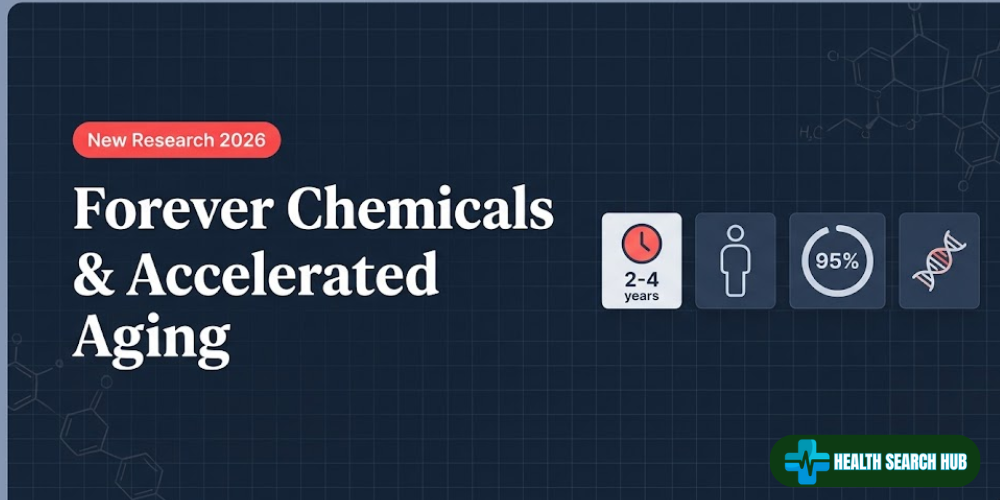
Two compounds stood out. Perfluorononanoic acid (PFNA) and perfluorooctane sulfonamido acetic acid derivative PFOSA were each detected in 95 percent of participants. Higher levels of these two chemicals were strongly associated with accelerated PFAS aging in men aged 50 to 64. PFNA exposure was associated with two to four years of accelerated biological aging as measured by GrimAge. This association was not observed in women.
Other widely recognized PFAS compounds, including PFOS, PFOA, and PFHS, showed no significant link with epigenetic aging. Similarly, methyl perfluorooctane sulfonamido acetic acid MPAH and ethyl perfluorooctane sulfonamido acetic acid EPAH, detected in at least 85 percent of participants, showed no meaningful connection to biological age acceleration. The fact that sulfonamido acetic acid EPAH and sulfonamido acetic acid MPAH were present yet inactive reinforces that health effects vary significantly by specific compound.

Why Are Middle-Aged Men More Vulnerable?
Overall, PFAS concentrations did not differ significantly between men and women, suggesting that susceptibility rather than exposure level explains why men are more affected. Researchers believe midlife represents a sensitive biological window during which the body becomes more vulnerable to age-related stressors, which may explain why adults aged 50 to 64 responded more strongly to chemical exposure.
Lifestyle factors could also play a role. Epigenetic clocks are influenced by behaviors such as smoking, which remains more prevalent among men. When chemical exposures are layered on top of existing risk factors, the combined effect on biological aging may be compounded.
Why Legacy PFAS Regulations May Not Be Enough
Some well-known PFAS, including PFOS and PFOA, have been targeted for global phaseout under the Stockholm Convention. Many countries have restricted these legacy PFAS, and newer PFAS alternatives have entered the marketplace as replacements.
However, this study raises the question of whether those newer PFAS alternatives are necessarily low-risk replacements and warrant closer examination. PFNA and PFOSA, which have received less regulatory attention, may pose significant risks that legacy PFAS do not carry in the same way. France recently introduced a ban on PFAS in clothing and cosmetics, while the European Union is evaluating further restrictions. In the United States, the EPA has set enforceable drinking water limits for several PFAS compounds, but the regulatory landscape continues to evolve.
What the Study Does Not Prove
The study is cross-sectional, meaning PFAS exposure and aging markers were measured at the same time point. This design can identify associations but cannot prove that PFAS directly causes accelerated aging. The sample size of 326 adults, while nationally representative, is relatively small. Larger longitudinal studies will be needed to confirm these results.
A Warning That Demands Attention
The connection between polyfluoroalkyl substances PFAS and accelerated biological aging adds a significant new dimension to the growing evidence about forever chemicals. This research from the School of Medicine at Shanghai Jiao Tong University provides a clear signal that specific compounds are associated with measurable harm and that middle-aged men may be particularly vulnerable.
For individuals, practical steps such as using certified water filters, following local water advisories, and minimizing contact with stain-resistant or grease-resistant materials can help reduce daily PFAS exposure.
✨ Positive Takeaway
The ability to use epigenetic clocks to identify which specific chemicals are linked to accelerated aging represents a meaningful advance in environmental health science. This precision allows scientists and regulators to focus their efforts where they matter most, rather than treating all PFAS as a single threat. For individuals, the practical steps to reduce exposure are actionable, offering a measure of control amid a complex environmental challenge.
Sources
- Frontiers in Aging: Forever Chemicals PFAS — Faster Aging in Middle-Aged Men
- CNN Health: Men in Their 50s May Be Aging Faster Due to Forever Chemicals
- ScienceDaily: PFAS Found in Most Americans Linked to Rapid Biological Aging
- Journal of Hazardous Materials: PFAS Exposure and Epigenetic Age